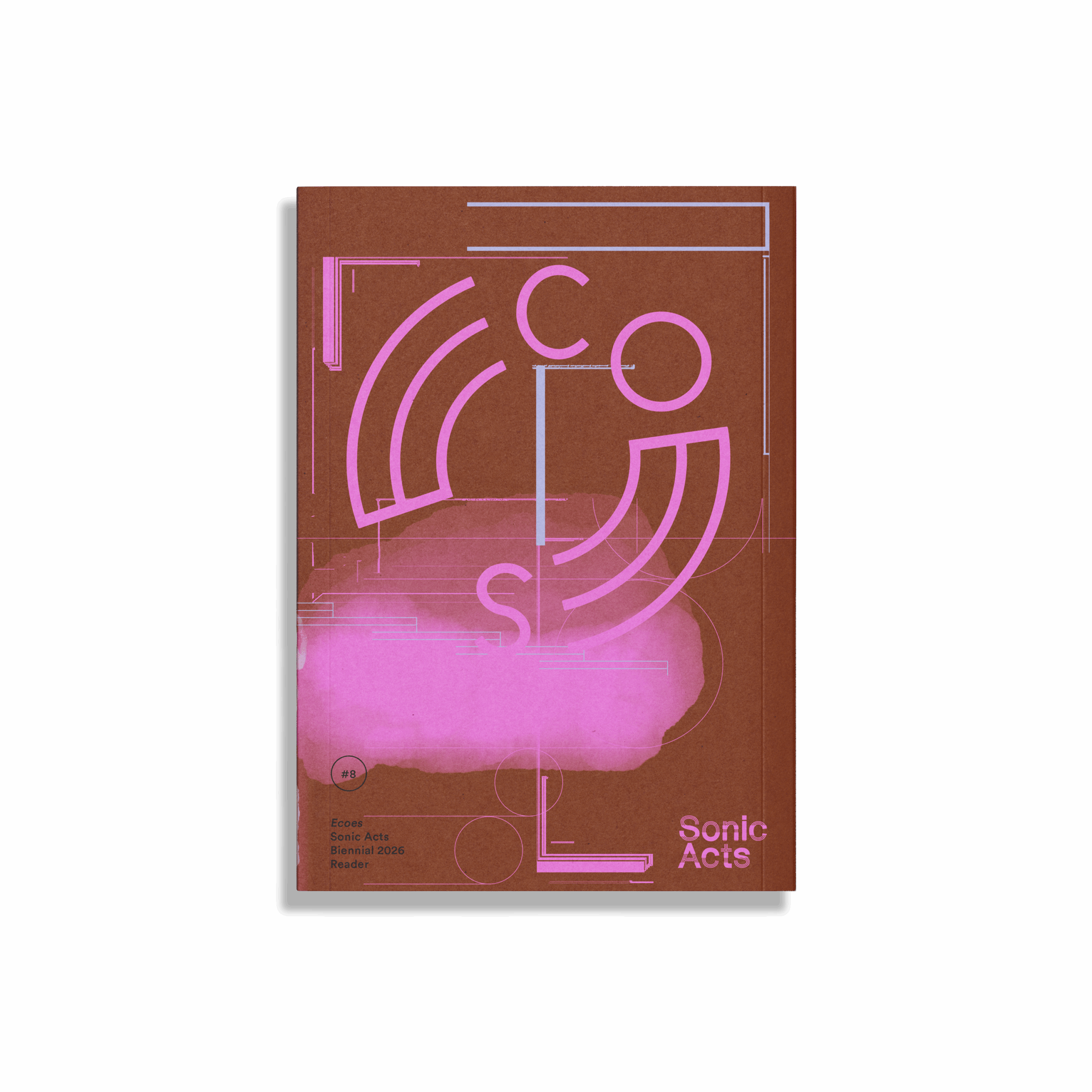
Ecoes is a magazine by Sonic Acts “rooted in environmental concerns and investigates how auditory practices shape our understanding of contemporary worlds — human and nonhuman.”
Here’s the information for the 8th issue, which you can buy at Sonic Acts:
In a world marked by crises, conflict, and displacement, we all long for a place to call home. But what happens when these places fail to offer a safe refuge, or when they are no longer within reach, taken from us, or lost to time?
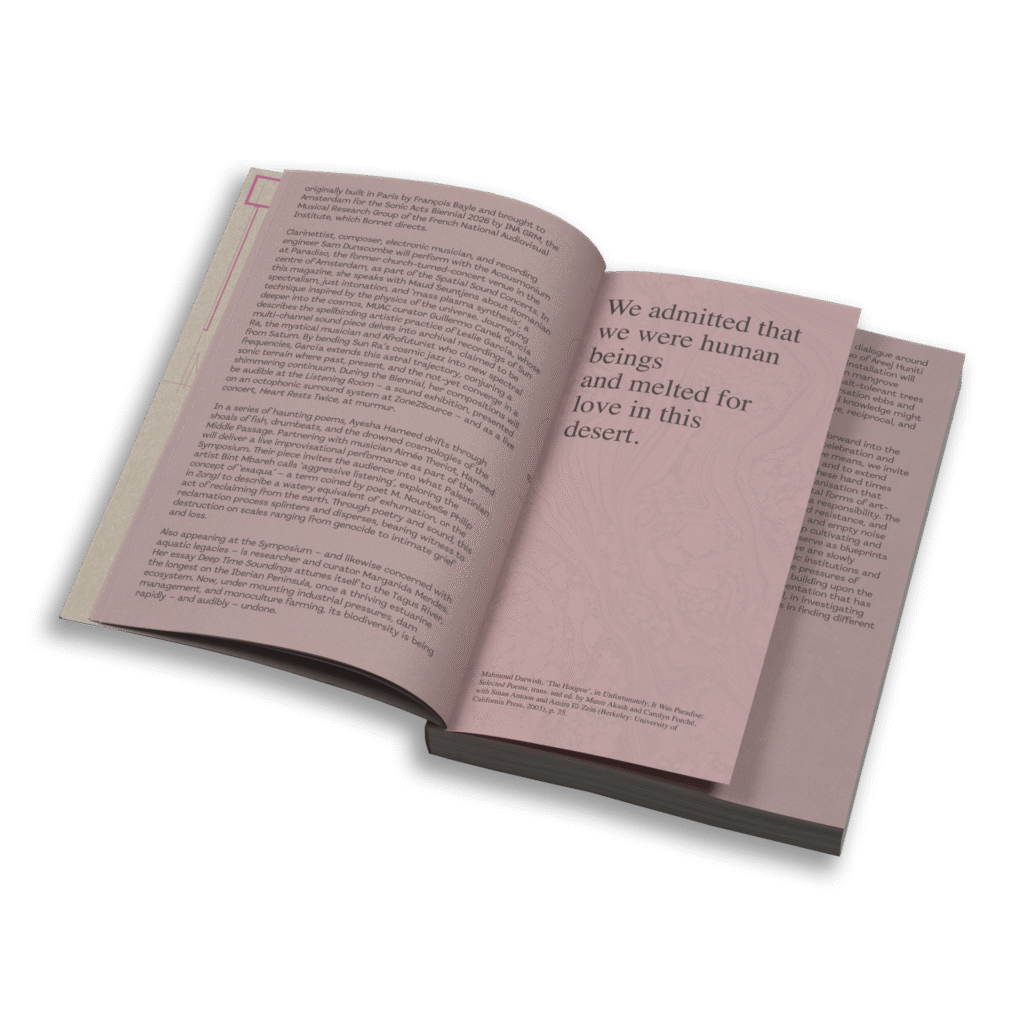
This magazine – which serves as the reader for Sonic Acts Biennial 2026, Melted for Love – departs from this question, reimagining home not as a physical structure, but as a site of invitation, attentiveness, and care. Unfurling over its pages are the voices of artists, writers, and researchers who shape the Biennial programme, offering depth and orientation, with particular emphasis on the Symposium at the Stedelijk Museum, the multi-gallery exhibition, and the live concerts.
The reader opens with a double feature by Steve Goodman (Kode9), who examines the psychic and sonorous impacts of contemporary warfare through an extended conversation and an adapted extract from his forthcoming book Notes on the Third Ear. Sound as a tool for political testimony is also explored by Lawrence Abu Hamdan, whose script for the video (game) Zifzafa reflects his pioneering work in audio investigation and human rights advocacy. Travelling along waterways, Ayesha Hameed’s poetry glides through shoals of fish, drumbeats, and the drowned cosmologies of the Middle Passage, while Margarida Mendes attunes to the damaged ecosystems of the Tagus River, tracing the audible effects of environmental collapse.
Listening is an inherently relational medium, one that requires both focused attention and openness. This manifests in the work of Leslie García, whose multichannel sound composition transforms archival recordings of Afrofuturist musician Sun Ra, and in the writing of François J. Bonnet, director of the Musical Research Group of the French National Audiovisual Institute (INA GRM), who introduces his new publication, The Acousmonium Handbook.
In a multi-page visual contribution, Turner Prize-winning artist Jeremy Deller presents folk customs – from carnivals to pagan rites – as living, contested traditions. Further reflecting on place and nationhood, composer, performance artist, and vocalist Dylan Kerr considers the enduring scars of British colonial rule in Ireland.
Curatorial essays guide readers through the Biennial exhibition: Angeliki Tzortzakaki’s fragmentary text moves through the gallery spaces of W139, Arti et Amicitiae, and Rozenstraat, while Fabienne Rachmadiev provides vital context for the works presented at Framer Framed (a special collaboration with Sonic Acts). Further entry points come from exhibiting artists: the Lower Levant Company traces airwaves across time and empire through the murky history of the Near East Arab Broadcasting Station, while HUNITI GOLDOX attends to mangrove intelligence and coastal resilience.
Table of contents
Steve Goodman (Kode9): Emerging Futures, Collapsing Presents – Interview by Hannah Pezzack
Chronic Sonics – Steve Goodman
Zifzafa – Lawrence Abu Hamdan
The Case of Sharq al-Adna – Lower Levant Company
The Triumph of Art – Jeremy Deller
Irradiated Steppe – Fabienne Rachmadiev
Not Ever Gone: lalottacontinua – Angeliki Tzortzakaki
HUNITI GOLDOX: Mangrove Intelligence and Tidal Knowledge – Chiara Cartuccia
Deep Time Soundings – Margarida Mendes
Anton Kats: Resonances of Hope – Interview by Dominika Mikołajczyk
Exaqua – Ayesha Hameed
No Other Sound – Eleni Ikoniadou
Sondi: Refusal, Recognition, and Reworlding the Digital – Interview by Tiiu Meiner
Affective Logistics – Flavia Dzodan
Dylan Kerr: The Body as a Transducer – Interview by Franek Dziduch
Other Planes of There: On Leslie García’s Saturn Spectrums – Guillermo Canek García
François J. Bonnet: Creating Conditions for Music to Emerge – Interview by Arie Altena
Sam Dunscombe: Self Unsame Again Always New – Interview by Maud Seuntjens